Tuesday, October 29, 2013

an interruption by death

The Mower
Philip Larkin

The mower stalled, twice; kneeling, I found

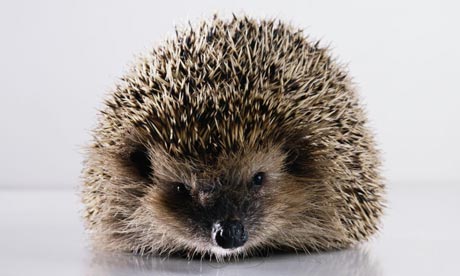
A hedgehog jammed up against the blades,
Killed. It had been in the long grass.

I had seen it before, and even fed it, once.

Now I had mauled its unobtrusive world
Unmendably. Burial was no help:

Next morning I got up and it did not.

The first day after a death, the new absence
Is always the same; we should be careful

Of each other, we should be kind

While there is still time.

I'm lucky that I don't witness death every day. When I think of coroners, crime scene investigators, embalmers, I can't even begin to imagine how they can so easily ignore the fact that the organism in front of them, still and unresponsive, cold and empty, was once a living and breathing being. Perhaps it hurts more when the one in front of you is someone or something familiar.

The narrator of Philip Larkin's "The Mower" explores how the death of a hedgehog opens his eyes to how he perceives death as a whole. 

An ordinary day of mowing the lawn begins for the narrator, until his lawnmower gets choked up by a hedgehog. Within the first stanza, his entire life shifts. A hedgehog, a Pagan symbol of fertility and appreciation of life, lies limp between the sharp blades of the mower. With this representation of feracity gruesomely gnarled and gnashed inside the lawnmower, Larkin writes not only of a literal death but also the death of an existence, of an idea. His act of mowing the lawn can represent his desire to mold or shape his world, while the hedgehog portrays the first casualty in his conquest. 

"I had seen it before, and even fed it, once." The narrator mentions this to show that he shared a connection with this hedgehog, no matter how small or trivial it may had been. His familiarity with the small creature references to the idea that deaths are more saddening when they're of someone or something familiar rather than a stranger or foreign being. The interactions he shared with this hedgehog were juxtaposed with the animal's death; he had fed the creature with the intent of keeping it alive. This represents the uncertainty of life and the many possibilities the future holds, even if there may not be a correlation between his feeding the hedgehog and its death.

He mentions that the burial did not help, for he continued to live while the hedgehog could not. This act of burying, though showing his dedication to sending off the creature, can also show his attempt to "bury" the first casualty in his attempt to change "the world," or his lawn. However, although hiding the hedgehog beneath the ground physically removes the creature from sight, it does not fact that an innocent being had its life snatched away. The absence, as he mentioned, is everlasting and remains to torment the narrator.

Larkin's poem concludes with the idea that all beings should live in consideration of others, taking into account that time is short for all living beings. However, it's odd that the narrator mentions being "careful / Of each other," seeing as the hedgehog's death supposedly isn't pre-planned. How could the narrator have been careful unless he knew that the hedgehog had a chance of reappearing in the grass? Therefore, it could be concluded that he isn't telling to be careful of harming others but rather of trying to manipulate one's world. Because the hedgehog died by the lawnmower, the narrator's act of mowing the lawn can be seen as the cause for his death; had he not been mowing the lawn, the hedgehog may still be living. By establishing this connection, one may conclude that Larkin is arguing against the exploration of our world, supporting instead the stagnation in order to minimize the amount of casualties (whether literal or not) around you.  

Sunday, October 27, 2013

how to live a life

"Enough! Who says I have to defend myself? I'm a machine, like you. Like all of you. Blood-lust and rage are my character. Why does the lion not wisely settle down and be a horse? In any case, I too am learning, ordeal by ordeal, my indignity. It's all I have, my only weapon for smashing through these stiff coffin-walls of the world. So I dance in the moonlight, make foul jokes, or labor to shake the foundations of night with my heaped-up howls of rage. Something is bound to come of all this. I cannot believe such monstrous energy of grief can lead to nothing!"

Within the eighth chapter of John Gardner's Grendel, Grendel appears to be in the midst of a nervous breakdown. At this point, he seems to be conflicted between the Shaper and the dragon's arguments on living life. 

As the dragon told him earlier, Grendel sought out his pile of gold and sat on it; he finds satisfaction out of grieving the Danes and continues to do so despite Hrothgar's misery. This shows his development from his previous belief that he no longer wanted to threaten the humans, that he wanted to "let them find some other 'brute existent'" (Gardner 73). During the war, Grendel initially seems angry with himself for his thirst of blood. He found it against his will, "mindless as wind," (Gardner 9) to feast upon the humans. His wish to become acquainted with the Danes is apparent when he storms the meadhall, crying out for mercy and peace, though the dragon argues that as long as Grendel exists, the humans will continue to unite against him. 

Although he did so when he was younger, Grendel begins to acknowledge his large superiority over the animals and humans. When he was but a child, he called himself an "ugly god" (Gardner 22), saying that he created the universe with every blink he blinked. His boasts are more prevalent after the arrival of Wealtheow, and he states that Hrothgar is his own creation. He justifies his manipulation and torturing of the king by saying that he is his experiment. By this, he attempts to play God by putting himself above the Danes. 

However, Grendel confesses that he is also a machine, mechanized by blind impulse and instinct just as the ram, the goat, and the humans. In addition with his language, Grendel also shares a methodical way of life with the Danes. Despite saying he was above all of instinctive behavior and has some sort of free will, he slowly begins to fall into that systematic habit of slaughter. What's interesting is that he backs this up by confessing his attacks were his only weapon for "smashing through these stiff coffin-walls of the world" (Gardner 123). By saying this, he is attempting to become his own Shaper in an effort to find a purpose in life. He rejects the purpose presented to him by the Shaper and tries to abide by his own idea which was brought upon him by the dragon, that the Danes' existence relies on his own.

Although he is trying to live by the dragon's advice, he refuses to acknowledge his idea that the world is meaningless, that "in a billion billion billion years, everything will have come and gone several times, in various forms" (Gardner 70). With the Shaper, even if it is false, Grendel is given a reason to live, whereas the dragon claims it's all for naught, that in time no one will even know he even existed. 

As for me, I believe I try to live by the Shaper's words but end up being driven mad by those of the dragon. I've acknowledged that time is quickly passing by and I shouldn't waste time worrying about the inevitable end, but I can't shake the feeling that within a hundred years, nothing I've done will hold any significance. With seven billion individuals in the world, living and dying every second of every day, what difference can I really make? Even more, why does it matter that I make a difference? I feel as though so long as I enjoy the present, there's no need to squander my time fearing oblivion.

Monday, October 7, 2013

the love song of George Willard

"It is impossible to say just what I mean!"
- T.S. Eliot, "The Love Song of J. Alfred Prufrock"

"One shudders at the thought of the meaninglessness of life while at the same instant... one loves life so intensely that tears come into the eyes." 
- Sherwood Anderson, Winesburg, Ohio


T.S. Eliot's J. Alfred Prufrock and Sherwood Anderson's George Willard both share a fear of the future. For J. Alfred, his fear is more focused on the limited time and life he has left; for George, his fear is of maturity and "sophistication." 

Throughout Eliot's "The Love Song of J. Alfred Prufrock", the narrator is struggling to express his emotions; he wonders how he would go about communicating his feelings, eventually using up all his time uncommunicative. He acknowledges the amount of life that can occur in such little time: "In a minute there is time/For decisions and revisions which a minute will reverse" (Eliot 47-48). J. Alfred also realizes that time has past him by, that he's grown old with "a bald spot in the middle of [his] hair" (Eliot 40), representing his age and perhaps the knowledge he accumulated over his lifetime. Despite this recognition, he continues grappling with his inability to voice his emotions, fearful of the misunderstanding that he may receive in return. 

This concept of understanding is also represented throughout Sherwood Anderson's Winesburg, Ohio. George Willard portrays the coming-of-age character of the work, to whom multiple characters attempt to teach the truths of life. Wing Biddlebaum tells George that he's destroying himself, that he "must begin to dream" (Anderson 30). In contrast, George's father tells his son to wake up, while Wash Williams informs George that he must stop dreaming and that he wishes to destroy the dreams in the reporter's head. Kate Swift tells him that "it's time to be living" (Anderson 163). This dream state could be equivalent to his lack of maturity during his childhood, in which he has yet to come in conflict with real world problems. His awakening could represent his maturation into adulthood, when he stops concerning himself with affairs with multiple women and begins focusing on his future. 

J. Alfred and George both reach the point where they question every little thing they do. It begins for J. Alfred when he begins to wonder the worth of the minuscule happenings, of "the sunsets and the dooryards and the sprinkled streets" (Eliot 101). He also questions future actions, as simple as eating a peach or parting his hair. His inquisitive state reveals his understanding that every small part of his life makes a difference in the long run. As George makes his departure from Winesburg, "the serious and largest aspects of his life did not come into his mind" (Anderson 247); instead, he also thinks of the little things. He reaches a point when he "takes the backward view of life" (Anderson 234) in which he evaluates how meaningless his life has been. He equates his life up to that point as a leaf blowing in the wind, resembling how weak and dispassionate he's been throughout his adolescent years. This marks his acknowledgment that he wishes to make a change in the future and become more of a "man."

Monday, September 30, 2013

the downfalls of Wing and a creature

Why are we so drawn to tragedy and violence?

From TV shows to video games, novels to movies, these two characteristics draw the attention of many individuals. Sure, there are pacifists and peacemakers, optimists and promoters of love, but they would never have been drawn to peace and happiness hadn't there been war and sadness. Only once the effects and emotions of conflict became known have these individuals yearned for halcyon. 

While reading Winesburg, Ohio, I can honestly say I was instantly drawn to the stories in which some violent, tragic event took place. I did get a rush from analyzing seemingly innocent passages and finding hidden meanings behind them -- Wash Williams and his garden? Hell-ooo, fertility symbolism! -- but I was most interested in the cataclysms of the work, specifically those of Wing Biddlebaum.

Within "Hands," we learn of Wing and his tragic backstory as a school teacher. Accused of touching his children, he is physically beaten by one of the fathers of the students he taught; "tired of beating the master, [he] had begun to kick him about the yard" (Anderson 32). Even more sickening, Wing is attacked by angry townspeople, "throwing sticks and great balls of soft mud" (Anderson 33). His fear and weakness were fuels for the townspeople, who continue to torment him until he is eventually driven out of the town. 

This portion of the story greatly resembles one of Mary Shelley's Frankenstein, in which Frankenstein's creature is chased out of a village. Just as in "Hands," the creature was attacked, "grievously bruised by stones and many other kinds of missile weapons" (Shelley 74). The creature, grossly misunderstood, is unable to reveal his docile nature as a result of his disfigured appearance; on the other hand, Wing is misunderstood, and although he's able to express his quiet character, he chooses not to. 

So why is it that the creature chooses to act out while Wing remains closed off?

Perhaps it is because the creature has never experienced the love associated with a parent, with a partner, or with a friend. His attempts to find a companion failed; his struggles to communicate with others were met with disdain; his deeds of kindness were not returned. Having received only hate and never love, the creature became consumed with this hatred that triggered an impulse to lash out.

In Wing's case, he has the experience of a schoolteacher to tell him what it's like to be loved. Leading up to his horrifying escape from town, Wing was "much loved by the boys of his school" (Anderson 31); he has significant knowledge of expressing love and receiving that love in return. It was the sudden violent acts against him that led Wing to doubt himself, to believe that he had lost the love he had once treasured dearly. With this belief, he begins to hide his major means of expressing love: his hands. 

The tragic downfalls of Wing Biddlebaum and Frankenstein's creature are not dissimilar; they both made decisions that would either hide or eliminate the love they had within themselves. It's these decisions that makes me so interested in them. I wonder if their lives would've been so marred with tragedy and violence had they not made these decisions.

Sunday, September 29, 2013

it may not always be so; and i say

it may not always be so; and i say
e.e. cummings

it may not always be so; and i say
that if your lips, which i have loved, should touch
another's, and your dear strong fingers clutch
his heart, as mine in time not far away;
if on another's face your sweet hair lay
in such silence as i know, or such
great writhing words as, uttering overmuch, 
stand helplessly before the spirit at bay;


if this should be, i say if this should be--
you of my heart, send me a little word;
that i may go unto him, and take his hands,
saying, Accept all happiness from me.
Then shall i turn my face, and hear one bird
sing terribly afar in the lost lands.


In e.e. cummings' "it may not always be so; and i say," the narrator seems to be contemplating his fear of the unknown. The main issue of the poem could be the strength of the relationship between the narrator and his lover; he appears worried that his lover will eventually leave him for another, but despite knowing this potential fate, he will continue to love his partner.

The organization of the poem depicts how strongly the narrator feels towards his lover. Overall, the poem is listing future actions the narrator's lover may do with another, and the narrator concludes that he will "go unto him, and take his hands, / saying, Accept all happiness from me" (lines 11-12). However, immediately after this, he talks of turning a face, a sign that he isn't actually accepting of the situation. As one turns his or her face from a lover, it's usually because of an expression that would betray his or her actual emotions. It could be assumed, therefore, that the narrator, despite his actions, may never recover from the idea that his lover will leave him. He nevertheless sacrifices his own happiness for his lover's, hiding his own dissatisfaction in an attempt to appear optimistic for the future.

Specifically with "if your lips, which i have loved, should touch / another's, and your dear strong fingers clutch / his heart" (lines 2-4), the narrator seem detached from this "other" individual. The placement of "another's" and "his heart" in separate lines could represent the division the narrator feels from his lover; it could symbolize his hesitance towards the idea that there's "another" with whom his lover could fraternize. Just as an individual would pause when questioning the future of the relationship between his or her lover, the narrator pauses, somewhat uncomfortably, at the thought of another lover. 

Unfortunately, it's impossible to precisely predict what will happen in the future. "i may go unto him" (line 11) represents the narrator's hope that he will do this, not that he will do it. Just as he fears his lover leaving him, he also fears his inability to cope with the situation. Throughout the poem, the narrator constantly uses "if" statements, only acting certain when he mentions that he shall "turn [his] face, and hear one bird / sing terribly afar in the lost lands" (lines 13-14). Although their future is indefinite, the narrator is confident that he would wallow in depression should his lover leave him. 

Because of the uncertainty of future outcomes, cummings could be arguing that thinking of the future is a trivial matter. The narrator of the poem seems immersed in love at the present time, only evoking sadness when he speaks of the future. Why should he spend time thinking about what could happen when he could be enjoying the time that he is spending with his lover? All relationships will eventually come to an end, whether it be through a split or through death; if the narrator concerns himself with this forthcoming end, he won't be able to find happiness in the present. 

Sunday, September 22, 2013

with all due respect

Andrew Wyeth, Christina's World, 1948
re·spect·a·ble
ri' spektəbəl
regarded by society to be good, proper, or correct; of some merit or importance
What does it mean to be respectable, or to have respectabilityIn Sherwood Anderson's Winesburg, Ohio, the concept of respectability is questionable. 
Within the work, Wash Williams, the telegraph operator of Winesburg, was a man of respect: "When Wash walked through the streets such a one had an instinct to pay him homage, to raise his hat or to bow before him" (Anderson 122). These actions resembled those conducted for a man or woman of high status, or having a quality that ranks them deserving of reverence. However, Wash is also associated with "a huge, grotesque kind of monkey, a creature with ugly, sagging, hairless skin below his eyes and a bright purple underbody" (Anderson 121). Despite being described as extremely ugly and dirty, he is also said to be courageous, as well as the best telegraph operator in the state. In this case, Wash's respectability is based on his confidence and his skillful abilities rather than his appearance. 
It appears that Wash has two different ideas of respectability. As he narrates his falling-out with his wife, his words make it seem as though he's lost respect for her: "'...I didn't want to touch them or her. I just sent her home to her mother and said nothing. There was nothing to say'" (Anderson 126). She was not, therefore, what would be determined as "good, proper, or correct." However, despite this, he treated her like a victim of the circumstance. It was clear that he felt lonely and betrayed after his wife had cheated on him, but he also tried to take all the blame off of her: "'I hated the men I thought had wronged her'" (Anderson 127). Instead of getting angry of her actions, he actually paid her all his savings and the money for the house. In addition, he became aggressive against her mother instead of her. Disregarding her affairs, Wash seemed to still hold some sort of respect or deference for her.
The only time that respect was explicitly included in the "Respectability" story was when Wash was at his wife's house: "'I sat in the parlor of that house two hours... Their house was stylish. They were what is called respectable people. There were plush chairs and a couch in the room" (Anderson 126). Respectability at this point of the story has a more superficial feel than previous implications. Wash described them as "respectable" simply by their home, or by their appearance of being "respectable". This could also be similar to the meaning of "sophistication" in the story entitled "Sophistication." Within that story, George Williard was concerned of acting sophisticated and manly in front of Helen White, even though it made him act in a manner that was unnatural and phony. In fact, the definition of sophisticate is "to make impure, adulterate; to cause to become less natural." Despite their appearances of sophistication, both George and Helen were both still young and wild, eventually regressing to "excited little animals" (Anderson 242). The concepts of respectability and sophistication within Anderson's work are treated as superficial qualities, only associated with individuals who act fake.

Sunday, September 15, 2013

a Tintern of events

Benjamin Williams Leader Paintings, Tintern Abbey, 1831-1923
          The sounding cataract
Haunted him like a passion: the tall rock,
The mountain, and the deep and gloomy wood,
Their colours and their forms, were then to him
An appetite; a feeling and a love,
That had no need of a remoter charm,
By thought supplied, or any interest
Unborrow'd from the eye.


In this passage from Wordsworth's Tintern Abbey, the narrator recalls how he felt about nature when he was younger. According to him, nature no longer interests him as an "appetite" needed to be satisfied. Appetite can be defined as an instinctive physical desire, a strong wish or urge. However, his words are hypocritical to how he described nature as a boy.

Earlier in the poem, he had mentioned how his ventures into nature were "more like a man flying from something that he dreads, than one who sought the thing he loved" (Wordsworth 71-73). Nature when he was younger, therefore, was more of an escape than a place of desire. Even as he grew older and mature, Wordsworth began to immerse himself into nature in an attempt to realize his own sense of self, allowing nature to serve as a protective barrier. He described nature as "the anchor of my purest thoughts, the nurse, the guide, the guardian of my heart, and soul of all my moral being" (Wordsworth 110-112). 

Shelley's characters in Frankenstein were largely influenced by nature. The passage from Tintern Abbey was specifically quoted when Frankenstein and Clerval were traveling down the Rhine; Frankenstein was bothered by his task to create a female counterpart for his creation, and Clerval was fascinated by the landscape and scenery surrounding him. However, Clerval was enjoying nature not as a means of escape but rather out of admiration for the setting: "'This is what it is to live,' he cried; 'now I enjoy existence!'" (Shelley 112). As for Frankenstein, his interest in his friend's reaction towards the natural world acted as an escape; his friend's delight allowed Frankenstein to momentarily forget the stressful situation he was in. 

Following the passage of the poem, Wordsworth spoke of how that time was past, "and all its aching joys are now no more, and all its dizzy raptures" (Wordsworth 85-86). It's difficult to understand whether it's the present or the past that the narrator finds more favorable; despite equating nature to love, he also characterized it as having "aching joys." I believe that the joys are aching because they're reminders of simpler times, back when Wordsworth still had his innocence and youth. In a way, this could be equal to the memories Frankenstein had of his friend while they were traveling down the Rhine. As those days were the days he was happiest yet they reminded him of the last days he spent with Clerval, his memories could be described as "aching joys" as well.

Tintern Abbey as a whole was a story focusing on external nature versus internal nature, where the focus shifted from the physical aspects of the natural world to the hidden meaning and significance of it all. In relation to Frankenstein, this conflict between external and internal is similar to the characteristics of both Frankenstein and his creation and the war they have concerning their outward appearances and their inner desires.