Monday, December 9, 2013

dolls in a dollhouse

Within A Doll's House and Age of Innocence, the females can be seen as dolls living in a dollhouse. Nora Helmer and May Welland are introduced as very naïve characters, filled with either innocence or ignorance of real-world issues. However, there may be more to their natures than meets the eye.

During the first act of Henrik Ibsen's play, Nora seems like a troublesome wife; she spends money recklessly and insists upon asking for more when it's all spent. She plays to her feminine attributes to get what she wants out of her husband, "playing with his coat buttons, and without raising her eyes to his," requests more money to purchase more (Ibsen, line 99). 

When Kristine Linde arrives, it's clear that she's been having troubles with her life. Widowed and childless, Kristine tries to find work as she feels her life is "unspeakably empty, [with] no one to live for anymore" (Ibsen, lines 334-335). Despite being told this, Nora seems insistent upon bragging about how lovely her life has been and how wonderfully her children have grown. She talks about how she "mustn't be selfish today; today [she] must only think of [Kristine's] affairs" (Ibsen, lines 245-246), but immediately after this she goes on and on about how splendid it is "to have heaps of money and not need to have any anxiety" (Ibsen, lines 259-260). Her lack of concern for her friend's troubles shows how self-concerned she is.

According to Newland Archer from Edith Wharton's novel, May Welland "simply echoed what was said for her" (Wharton 69), unable to voice her own thoughts and ideas. He found her terribly dull and bland, with "innocence that seals the mind against imagination and the heart against experience" (Wharton 123). Her similarities to somewhat of a dummy or a puppet repels Newland, who is later attracted to the new and mysterious Ellen Olenska, who speaks strangely unlike any other.

While Torvald Helmer sees his relationship with Nora being one in which he is forced to pay for her expenses, Newland views his marriage with May to be a nuisance as well. He fears of it becoming "a dull association of material and social interests" (Wharton 37). His desire to keep this from happening forces him not to try and fix their marriage but rather seek out a new woman to satisfy him. However, further into their marriage, May begins to act as her mother, and Newland's fear of "gradually [sinking] into the placid and luxurious routine of their elders" (Wharton 107) becomes reality.

Despite how dependent and ignorant they initially seem, both Nora and May are secretive and conniving, scheming behind their husbands' backs. 

Nora's obsession with money turns out to be due to debt, not her need to buy everything. Her ability to manage money without her husband's knowledge, in spite of some inaccurate knowledge she may have about economics, shows that she is able to act independently from her husband. By seducing her husband, she can get money from him in order to pay off her debt to Krogstad, revealing plans that she's kept in the dark for a long time.

May, on the other hand, is knowledgeable of Newland's affair with Ellen. She uses this knowledge to her advantage and manages to push Ellen away from fraternizing with her husband by informing her that she's with child. Though it's not clear exactly when she finds out about her husband's cheating, May still manages to keep her knowing a secret from Newland, despite of all the grievances it may cause her.

Saturday, November 30, 2013

you fit into me

You Fit Into Me
Margaret Atwood

You fit into me
like a hook into an eye

a fish hook
an open eye 


A fish hook into an open eye. Now, simply typing that down makes my knees buckle. 
Why is it that this narrator is telling an individual that their fit resembles that of a fish hook into an open eye? 

Perhaps it's the duality of love working through this poem. 

When I think about one's significant other, I imagine that he or she fits the other person fairly well, as puzzle pieces fit together to create one whole. From the beginning of Atwood's poem, I understand that she tries to convey this idea of a perfect fit. The narrator states that the partner fits into him or her, stating that this resembles a hook and an eye.

For garments, this idea of hooks and eyes acting as a fit makes sense. One method of fastening clothing together, after all, is known as a hook-and-eye closure. Commonly used in brassieres, the hook-and-eye closure has been utilized since 14th century England. Typically, the hook is a flattened wire bent to fit inside an eye, or an opening onto which the hook can latch itself. 

Initially, the two described in the poem seem to be very compatible with each other, having a fit resembling the hook-and-eye closure. However, clarification is given in the last two lines of the poem, the hook being a fish hook and the eye being an open eye. As it turns out, the fitting isn't all that fantastic.

Fish hooks are used to, obviously, hook fish. Resembling a 'J', a fish hook has a jagged point at its end in order to guarantee a catch. It's designed to pierce the lip of a fish, and its curve prevents the fish from throwing the hook. Part of a fish hook is known as the eye, which is the small hole at the end of it that is tied onto a fishing line. From connotation, a fish hook can represent capture. Fish hooks are difficult for fish to shake free from, so it can also symbolize stubbornness. 

As my optometrist once told me, it takes a lot of pressure to pierce through your eye. Because I get weak just from typing that down, I don't feel comfortable researching the exact amount needed to penetrate the eyeball. However, as the fish hook from Atwood's poem so easily fits into the eye, I would assume that the pressure is great. What makes it all the more sickening is that the eye is open while this is happening. The individual is observing as the fish hook enters his or her eye, which shows that the narrator is not blind to what's going on. He or she knows that the pain will be great and difficult to remove but allows for it to happen all the same. 

This, I believe, expresses the duality of love. Although the two in the poem are the perfect fit for each other, it comes with pain as would come from a fish hook in an open eye. As innocent as love may initially seem, it can also be a painful process.

Wednesday, November 20, 2013

a Grendel of youth and experience

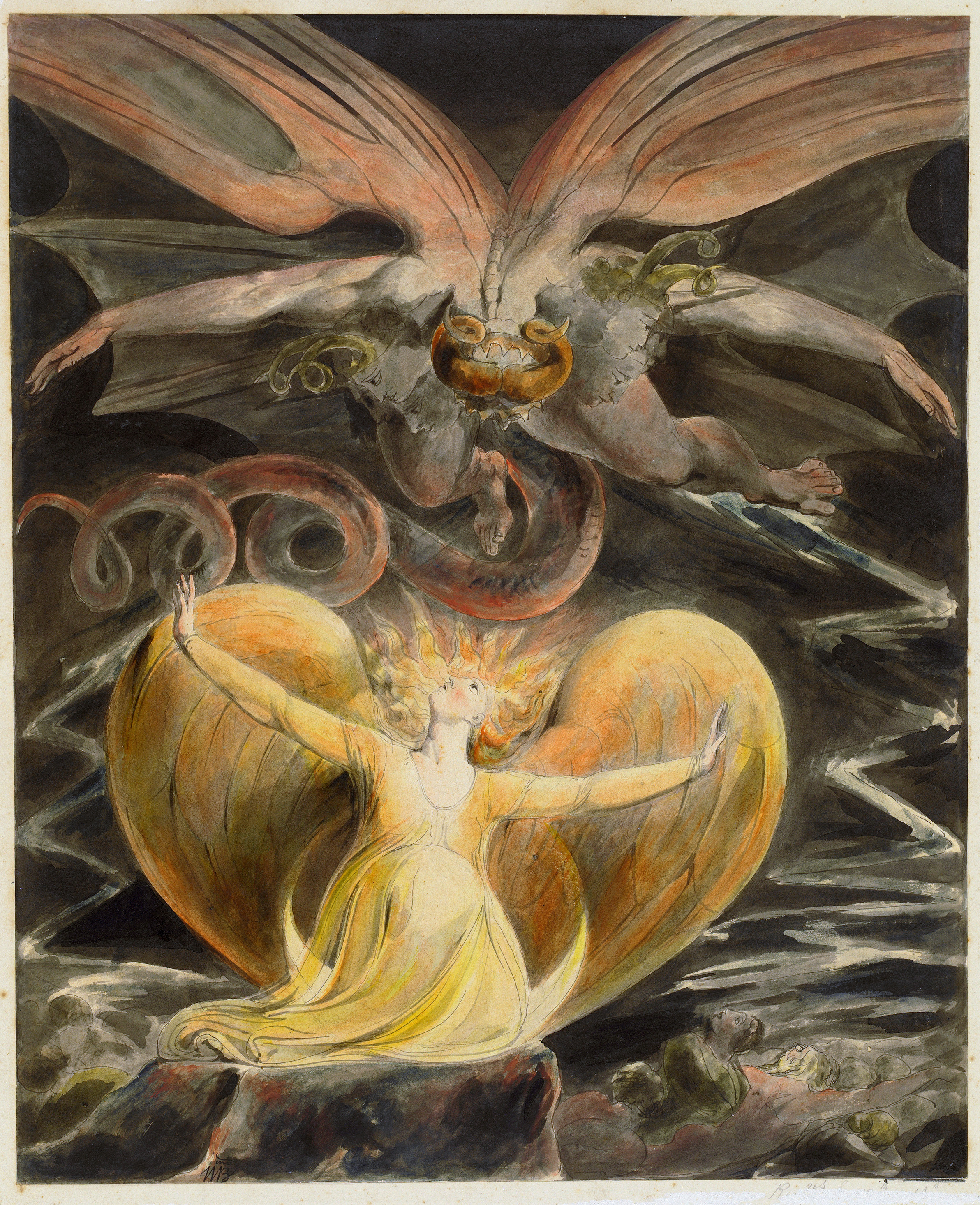
William Blake, The Great Red Dragon and the
Woman Clothed with the Sun,
1805
Grendel can be characterized as a product of William Blake's works concerning the influences of innocence and experience. 

When he speaks of his childhood, Grendel reminisces of a period free from intrusion of religion, free from the violence that he soon comes to know. He participates in games with "ingenious twists into freedom or new perplexity" (Gardner 15), revealing his preparedness for exploring the world around him. In my mind, I imagine a young Toothless from Pixar's How to Train Your Dragon prancing around a forest, observing various plants and creatures as if they were all new to him. 

However, Grendel mentions that occasionally "the spell would be broken suddenly" (Garnder 16), and he starts noticing large shapes with eyes watching him. Though it's unclear what these masses may be, they make him "feel, all at once, alone and ugly, almost... obscene" (Gardner 17). A shape could be defined, as Blake writes in "Infant Sorrow," "like a fiend hid in a cloud" ("Infant Sorrow," line 4). Although they remain ambiguous in features, the shapes seem to be "hiding" behind Grendel's innocence, waiting for experience to shape Grendel; this could also be seen when Grendel sees the shapes and doesn't understand what they mean, showing that he doesn't yet have knowledge of certain things. 

As Grendel is taught by the Shaper, his mentor could act like the guardian mentioned in Blake's "Introduction" to Songs of Innocence. The Shaper within Grendel fulfills the role of maintaining the naivety and innocence of the Danes; he performs songs that speak to them of "truths" that may be warped in order to protect his people. His character could be related to the piper in the Song of Innocence. The piper within the "Introduction" performs and sings songs of "merry chear" ("Introduction," line 6) for a young child, all of which reduce the boy to tears of joy. These songs, as the Shaper's songs do, satisfy the audience on an emotional level. Before the end of the poem, the piper mentions that he "wrote [his] happy songs, / Every child may joy to hear" ("Introduction," lines 19-20), which reveals that his audience is not only the young boy but all who may wish to hear. As Grendel is eavesdropping on the Shaper's performances, he acts as the young boy, but the audience is made up of all the Danes who listen to the songs. 

The dragon in Grendel could act as the Bard from Blake's "Introduction" to Songs of Experience. Within the novel, the first encounter between Grendel and the dragon can signify the moment when his innocence is lost; the dragon takes advantage of the conversation to try and convince Grendel that the world is all "ashes to ashes, slime to slime" (Garnder 73). It's during this exchange that Grendel learns that his search for love and acceptance may be pointless, and all his efforts will eventually lead to nothing following the end of his life. The dragon supports his claims by telling Grendel that he knows everything, "the beginning, the present, the end" (Garnder 62). This line is remarkably similar to one in the "Introduction" to Songs of Experience, in which the Bard is described as one "Who Present, Past, & Future sees" ("Introduction", line 2). With the similarity of experience between the dragon and the Bard, the two act as sources of "true" knowledge for Grendel, as opposed to the revised songs of the Shaper. 

Grendel's youth represents his period of innocence for which he begins longing for after he participates in war against the Danes. His destructive forces during the war highlight his experienced self, accumulation of knowledge presented to him by both the Shaper and the dragon. Although Blake placed importance on neither innocence nor experience, Grendel's character seems to find the innocent self to be a stage more preferable than the experienced self. 

Sunday, November 10, 2013

water and Grendel


According to the dragon in John Gardner's Grendel, life has no meaning. Life is all "a swirl in the stream of time. A temporary gathering of bits, a few random dust specks, so to speak" (Gardner 70). His thoughts suggest that the world eventually come to nothing, and that nothing will have no meaning either - just a "mere ripple in Time's stream" (Gardner 71). 

The nihilism the dragon presents can also be seen in Red Horse, an old man with whom Hrothulf converses. According to Red Horse, "the total ruin of institutions and morals is an act of creation" (Gardner 118). This is a belief reflecting nihilism, in which destruction of political or social institutions is necessary for improvement. Unlike the dragon, however, the old man promotes the idea of revolution and anarchy with the thought that this will allow for a new existence. It wouldn't be the inferior versus the superior, but rather two equally powerful forces fighting for freedom. On the other hand, the dragon finds that an act of destruction "not a real ending of course, nor even a beginning" (Gardner 71), but that it is rather an accident of time. 

Juxtaposition of destruction and creation is a common thread in Grendel. The Danish priests refer to their God as the Great Destroyer, hoping that the Destroyer will "defend the people of Scyld and kill their enemy, the terrible world-rim-walker" (Grendel 127). In destroying Grendel, the Destroyer would also be allowing the Danes to continue with their existence. Because Grendel, the so-called world-rim-walker and evil enemy against the Danes, poses as the Destroyer, he highlights the connection between destruction and creation, as Red Horse implies as well.

In David Foster Wallace's This Is Water commencement speech, he unknowingly presents an argument to counter that of the dragon. Wallace presents his belief that there is no one meaning to life. Instead of one true purpose, he proposes that the individual has the choice to make his or her own purpose. 

Grendel represents an individual who doesn't live his life through his own self-created purpose; instead, he is influenced by the Shaper and the dragon who create a purpose for him. The Shaper sings the song of Cain and Abel whose feud "split all the world between darkness and light" (Gardner 51), with Grendel representing this darkness. Grendel, eavesdropping on his performance, takes his story for truth and begins to mold his life around the idea that he's an evil force. The dragon further reinforces this belief by telling Grendel that he is "the brute existent by which they learn to define themselves" (Gardner 73). By giving him this role of creator, he limits Grendel to act in a way that implies the Danes will act according to his actions. 

Near Grendel's death, it seems as though a wave of realization washes over him, as "the long pale dream, my history, falls away" (Gardner 169). It could be assumed that at this time, he realizes that he's been so engulfed in fulfilling the Shaper's and the dragon's purposes of him that he's dived headfirst against a foe that would be his downfall. This moment of enlightenment has him longing to regress back to his childhood, seen as he cries out for his mother during his final moments. His desire to return to the childlike Grendel, before he met the Shaper or the dragon, can also be found after his attempts to split Wealtheow, when he hopes to kill himself "for love of the Baby Grendel that used to be" (Gardner 110).


Tuesday, October 29, 2013

an interruption by death

The Mower
Philip Larkin

The mower stalled, twice; kneeling, I found

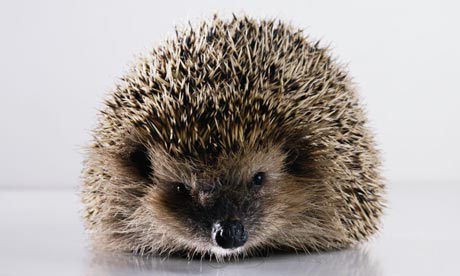
A hedgehog jammed up against the blades,
Killed. It had been in the long grass.

I had seen it before, and even fed it, once.

Now I had mauled its unobtrusive world
Unmendably. Burial was no help:

Next morning I got up and it did not.

The first day after a death, the new absence
Is always the same; we should be careful

Of each other, we should be kind

While there is still time.

I'm lucky that I don't witness death every day. When I think of coroners, crime scene investigators, embalmers, I can't even begin to imagine how they can so easily ignore the fact that the organism in front of them, still and unresponsive, cold and empty, was once a living and breathing being. Perhaps it hurts more when the one in front of you is someone or something familiar.

The narrator of Philip Larkin's "The Mower" explores how the death of a hedgehog opens his eyes to how he perceives death as a whole. 

An ordinary day of mowing the lawn begins for the narrator, until his lawnmower gets choked up by a hedgehog. Within the first stanza, his entire life shifts. A hedgehog, a Pagan symbol of fertility and appreciation of life, lies limp between the sharp blades of the mower. With this representation of feracity gruesomely gnarled and gnashed inside the lawnmower, Larkin writes not only of a literal death but also the death of an existence, of an idea. His act of mowing the lawn can represent his desire to mold or shape his world, while the hedgehog portrays the first casualty in his conquest. 

"I had seen it before, and even fed it, once." The narrator mentions this to show that he shared a connection with this hedgehog, no matter how small or trivial it may had been. His familiarity with the small creature references to the idea that deaths are more saddening when they're of someone or something familiar rather than a stranger or foreign being. The interactions he shared with this hedgehog were juxtaposed with the animal's death; he had fed the creature with the intent of keeping it alive. This represents the uncertainty of life and the many possibilities the future holds, even if there may not be a correlation between his feeding the hedgehog and its death.

He mentions that the burial did not help, for he continued to live while the hedgehog could not. This act of burying, though showing his dedication to sending off the creature, can also show his attempt to "bury" the first casualty in his attempt to change "the world," or his lawn. However, although hiding the hedgehog beneath the ground physically removes the creature from sight, it does not fact that an innocent being had its life snatched away. The absence, as he mentioned, is everlasting and remains to torment the narrator.

Larkin's poem concludes with the idea that all beings should live in consideration of others, taking into account that time is short for all living beings. However, it's odd that the narrator mentions being "careful / Of each other," seeing as the hedgehog's death supposedly isn't pre-planned. How could the narrator have been careful unless he knew that the hedgehog had a chance of reappearing in the grass? Therefore, it could be concluded that he isn't telling to be careful of harming others but rather of trying to manipulate one's world. Because the hedgehog died by the lawnmower, the narrator's act of mowing the lawn can be seen as the cause for his death; had he not been mowing the lawn, the hedgehog may still be living. By establishing this connection, one may conclude that Larkin is arguing against the exploration of our world, supporting instead the stagnation in order to minimize the amount of casualties (whether literal or not) around you.  

Sunday, October 27, 2013

how to live a life

"Enough! Who says I have to defend myself? I'm a machine, like you. Like all of you. Blood-lust and rage are my character. Why does the lion not wisely settle down and be a horse? In any case, I too am learning, ordeal by ordeal, my indignity. It's all I have, my only weapon for smashing through these stiff coffin-walls of the world. So I dance in the moonlight, make foul jokes, or labor to shake the foundations of night with my heaped-up howls of rage. Something is bound to come of all this. I cannot believe such monstrous energy of grief can lead to nothing!"

Within the eighth chapter of John Gardner's Grendel, Grendel appears to be in the midst of a nervous breakdown. At this point, he seems to be conflicted between the Shaper and the dragon's arguments on living life. 

As the dragon told him earlier, Grendel sought out his pile of gold and sat on it; he finds satisfaction out of grieving the Danes and continues to do so despite Hrothgar's misery. This shows his development from his previous belief that he no longer wanted to threaten the humans, that he wanted to "let them find some other 'brute existent'" (Gardner 73). During the war, Grendel initially seems angry with himself for his thirst of blood. He found it against his will, "mindless as wind," (Gardner 9) to feast upon the humans. His wish to become acquainted with the Danes is apparent when he storms the meadhall, crying out for mercy and peace, though the dragon argues that as long as Grendel exists, the humans will continue to unite against him. 

Although he did so when he was younger, Grendel begins to acknowledge his large superiority over the animals and humans. When he was but a child, he called himself an "ugly god" (Gardner 22), saying that he created the universe with every blink he blinked. His boasts are more prevalent after the arrival of Wealtheow, and he states that Hrothgar is his own creation. He justifies his manipulation and torturing of the king by saying that he is his experiment. By this, he attempts to play God by putting himself above the Danes. 

However, Grendel confesses that he is also a machine, mechanized by blind impulse and instinct just as the ram, the goat, and the humans. In addition with his language, Grendel also shares a methodical way of life with the Danes. Despite saying he was above all of instinctive behavior and has some sort of free will, he slowly begins to fall into that systematic habit of slaughter. What's interesting is that he backs this up by confessing his attacks were his only weapon for "smashing through these stiff coffin-walls of the world" (Gardner 123). By saying this, he is attempting to become his own Shaper in an effort to find a purpose in life. He rejects the purpose presented to him by the Shaper and tries to abide by his own idea which was brought upon him by the dragon, that the Danes' existence relies on his own.

Although he is trying to live by the dragon's advice, he refuses to acknowledge his idea that the world is meaningless, that "in a billion billion billion years, everything will have come and gone several times, in various forms" (Gardner 70). With the Shaper, even if it is false, Grendel is given a reason to live, whereas the dragon claims it's all for naught, that in time no one will even know he even existed. 

As for me, I believe I try to live by the Shaper's words but end up being driven mad by those of the dragon. I've acknowledged that time is quickly passing by and I shouldn't waste time worrying about the inevitable end, but I can't shake the feeling that within a hundred years, nothing I've done will hold any significance. With seven billion individuals in the world, living and dying every second of every day, what difference can I really make? Even more, why does it matter that I make a difference? I feel as though so long as I enjoy the present, there's no need to squander my time fearing oblivion.

Monday, October 7, 2013

the love song of George Willard

"It is impossible to say just what I mean!"
- T.S. Eliot, "The Love Song of J. Alfred Prufrock"

"One shudders at the thought of the meaninglessness of life while at the same instant... one loves life so intensely that tears come into the eyes." 
- Sherwood Anderson, Winesburg, Ohio


T.S. Eliot's J. Alfred Prufrock and Sherwood Anderson's George Willard both share a fear of the future. For J. Alfred, his fear is more focused on the limited time and life he has left; for George, his fear is of maturity and "sophistication." 

Throughout Eliot's "The Love Song of J. Alfred Prufrock", the narrator is struggling to express his emotions; he wonders how he would go about communicating his feelings, eventually using up all his time uncommunicative. He acknowledges the amount of life that can occur in such little time: "In a minute there is time/For decisions and revisions which a minute will reverse" (Eliot 47-48). J. Alfred also realizes that time has past him by, that he's grown old with "a bald spot in the middle of [his] hair" (Eliot 40), representing his age and perhaps the knowledge he accumulated over his lifetime. Despite this recognition, he continues grappling with his inability to voice his emotions, fearful of the misunderstanding that he may receive in return. 

This concept of understanding is also represented throughout Sherwood Anderson's Winesburg, Ohio. George Willard portrays the coming-of-age character of the work, to whom multiple characters attempt to teach the truths of life. Wing Biddlebaum tells George that he's destroying himself, that he "must begin to dream" (Anderson 30). In contrast, George's father tells his son to wake up, while Wash Williams informs George that he must stop dreaming and that he wishes to destroy the dreams in the reporter's head. Kate Swift tells him that "it's time to be living" (Anderson 163). This dream state could be equivalent to his lack of maturity during his childhood, in which he has yet to come in conflict with real world problems. His awakening could represent his maturation into adulthood, when he stops concerning himself with affairs with multiple women and begins focusing on his future. 

J. Alfred and George both reach the point where they question every little thing they do. It begins for J. Alfred when he begins to wonder the worth of the minuscule happenings, of "the sunsets and the dooryards and the sprinkled streets" (Eliot 101). He also questions future actions, as simple as eating a peach or parting his hair. His inquisitive state reveals his understanding that every small part of his life makes a difference in the long run. As George makes his departure from Winesburg, "the serious and largest aspects of his life did not come into his mind" (Anderson 247); instead, he also thinks of the little things. He reaches a point when he "takes the backward view of life" (Anderson 234) in which he evaluates how meaningless his life has been. He equates his life up to that point as a leaf blowing in the wind, resembling how weak and dispassionate he's been throughout his adolescent years. This marks his acknowledgment that he wishes to make a change in the future and become more of a "man."